A Father’s Lesson on Truth: The Buddha’s Advice to Rāhula
- Agama International
- 4 days ago
- 6 min read
Pause, check, reflect — and stay truthful with yourself
Some of the most memorable conversations in the Buddhist texts are not dramatic debates or lofty sermons. They are quiet, personal moments — and this is one of them.
In this sutta, the Buddha speaks to Rāhula, his son. Before he began his spiritual journey, Siddhattha Gotama lived as a prince and father. According to the traditional account, he left palace life at the age of 29, setting out in search of a way to end all human suffering. He left behind his family, including his young son Rāhula. Years later, after his awakening, Rāhula joined the monastic life and trained under him. That gives this teaching a very human depth: this is not only a master instructing a student, but also a father guiding his son.
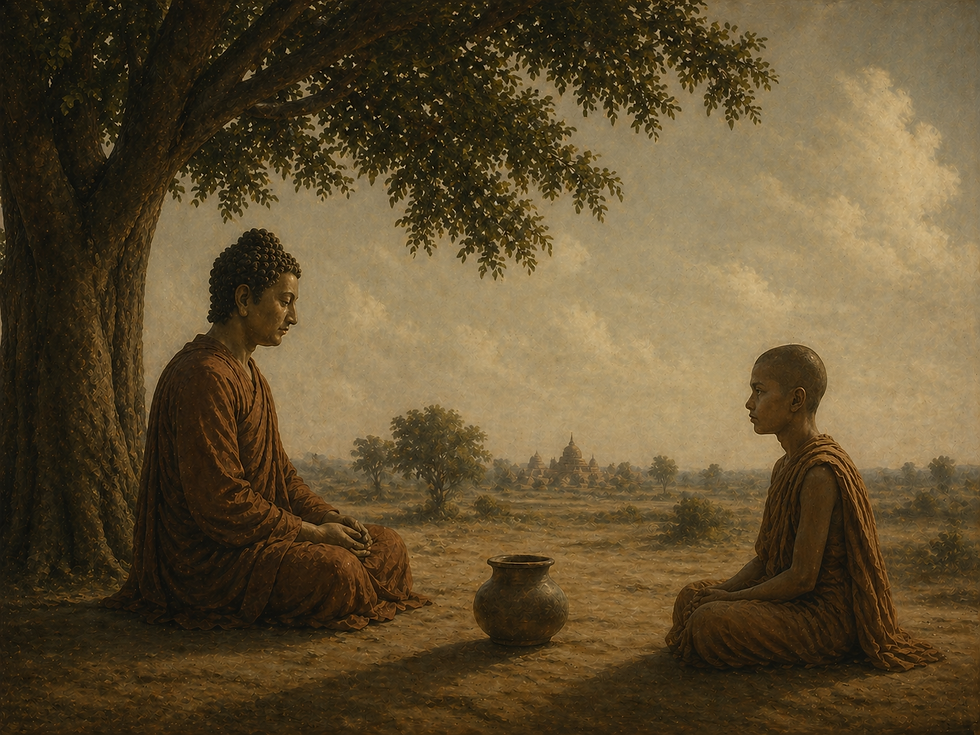
The conversation takes place near Rājagaha, one of the major cities of ancient India during the Buddha’s lifetime. Today, it is generally identified with Rajgir, in the state of Bihar, India. In the sutta, the Buddha is staying at the Bamboo Grove, while Rāhula is nearby at Ambalaṭṭhika. One afternoon, the Buddha goes to see him. Rāhula welcomes him respectfully, prepares a seat, and brings water for washing his feet. Then he sits down to one side, ready to listen.
What follows is one of the clearest teachings in the early Buddhist texts on truthfulness and self-reflection.

The Buddha Begins With a Water Pot
What is striking about this sutta is the Buddha’s teaching method. He begins with what is right there in front of them.
Leaving a little water in the pot used for washing his feet, he asks Rāhula:
“Rāhula, do you see this little bit of water left in the pot?”
“Yes, sir,” Rāhula replies.
The Buddha says:
“That’s how little of the ascetic’s nature is left in those who are not ashamed to tell a deliberate lie.”
Then he throws out the little water that remains. Again he asks:
“Do you see this little bit of water that was discarded?”
“Yes, sir.”
And again he explains:
“That’s how the ascetic’s nature is discarded in those who are not ashamed to tell a deliberate lie.”
Then he turns the pot upside down.
“Do you see how this pot is turned upside down?”
“Yes, sir.”
“That’s how the ascetic’s nature is turned upside down in those who are not ashamed to tell a deliberate lie.”
Then he turns it upright again and asks one more question:
“Do you see how this pot is vacant and hollow?”
“Yes, sir.”
And the Buddha says:
“That’s how vacant and hollow the ascetic’s nature is in those who are not ashamed to tell a deliberate lie.”
It is a vivid scene. The Buddha is not simply telling Rāhula that lying is wrong. He is showing him, step by step, how little goodness remains in someone who is not ashamed to tell a deliberate lie. It drains one's integrity away.
Why Lying Matters So Much
The Buddha goes further. He gives another image — a royal war elephant.
He describes a powerful elephant trained for battle. If it uses every part of its body except its trunk, the rider knows it is still holding something back. But if it even uses its trunk, then the rider knows the elephant has given itself completely; there is nothing it would not do.
Then the Buddha makes the comparison:
If a person is not ashamed to tell a deliberate lie, there is no wrong they would not do. That may sound strong, but the point is clear. Once truthfulness is abandoned, the inner boundary that protects us begins to weaken. If we can deceive others without shame, it becomes much easier to justify other harmful actions too.
So the Buddha gives Rāhula a training rule that is simple and memorable:
“I will not tell a lie, even for a joke.”
The Mirror Teaching
Then the teaching shifts.
The Buddha asks Rāhula, “What is the purpose of a mirror?”
Rāhula answers, “It’s for checking your reflection.”
And this becomes the heart of the sutta.
In the same way that a mirror helps us see our face, reflection helps us see our actions clearly.
The Buddha tells Rāhula to examine his actions of body, speech, and mind — not once, but repeatedly.
Before doing something, ask: Will this harm me? Will this harm others? Will this harm both? Will it lead to suffering, or to well-being?
While doing it, check again.
After doing it, look back honestly.
If the action was harmful, acknowledge it and resolve to do better. If it was wholesome, continue training in that direction with joy and care.
This teaching is practical in the deepest sense. It does not present ethics as a list of rules to follow once in a while. It turns truthfulness into a living practice of mindfulness.
Cultivating Mindfulness in Daily Life
One of the most valuable parts of this sutta is how precise it is.
The Buddha does not simply tell Rāhula, “Be careful,” or “Be good.” He gives him a method of training.
When it comes to actions of the body, Rāhula is told to reflect before acting, while acting, and after the action is done. The same pattern is given for speech. And even thoughts and intentions — actions of the mind — are to be examined in exactly the same way.
This is more than moral instruction. The Buddha is teaching Rāhula how to observe himself clearly.
Truthfulness is not only an ethical principle here; it also becomes a basis for mindfulness. By checking body, speech, and mind again and again, Rāhula is learning how to stay present, honest, and awake to what he is doing.
This is not about guilt or harsh self-judgment. It is about training mindfulness. It is about learning to live with clarity, responsibility, and inner honesty.
In modern language, we might put it like this: pause, check, reflect — and stay truthful with yourself.
Why This Teaching Still Feels Fresh
Even though this conversation took place more than two thousand years ago, it still feels surprisingly immediate.
Most of us do not live in ancient India. We are not monks sitting in a grove near Rājagaha. But we do know what it is like to speak too quickly, bend the truth, act on impulse, or avoid looking too closely at our own motives.
That is why this teaching still speaks so directly.
The Buddha’s advice to Rāhula is simple enough for a child to understand, but deep enough for adults to keep practicing for a lifetime:
tell the truth
examine your actions
admit when you were wrong
strengthen what is good
In that sense, truthfulness is not just a moral virtue. It is part of the training of attention. It teaches us to look carefully, to notice honestly, and to correct ourselves when needed.
That is a large part of the path, expressed in a very simple form.
Source: Majjhima Nikāya 61, Ambalaṭṭhikarāhulovāda Sutta (“Advice to Rāhula at Ambalaṭṭhika”); Madhyama Āgama 14, 羅云經 (“The Discourse to Rāhula”).
Editor’s Note
Two points stand out strongly in this discourse.
First, the Buddha’s teaching was never just a matter of giving verbal instructions. He lived among the monks day and night. People did not only hear his words; they also watched how he walked, spoke, responded, restrained himself, and related to others. In that environment, teaching and embodiment were inseparable. His words carried weight because they were closely aligned with his conduct.
That is worth reflecting on today, especially for parents, teachers, and anyone who hopes to guide others. We may tell our children to be truthful, to reflect before speaking, and to watch their actions. But can we model that ourselves? Can we stay honest, examine our own motives, and keep discerning our behavior day by day? Very often, the force of our words depends on whether our lives support them.
Second, this discourse shows that the Buddha was not only teaching Rāhula ethics in a narrow sense. He was also training him in mindfulness. As the sutta repeats, Rāhula is told to examine actions of body, speech, and mind before, during, and after they occur. Truthfulness is not just a moral rule here; it becomes part of the object of observation. One learns to watch oneself honestly, to remember the training, and to correct oneself in daily life.
This connects closely with a point we explored in an earlier post: in early Buddhism, mindfulness is not morally neutral, free-floating awareness. It is value-bound, directional, and rooted in the path. It includes recollection, clear knowing, and ethical orientation. It remembers what matters, what leads to harm, and what leads to freedom. In that sense, the advice to Rāhula is an excellent example of early Buddhist mindfulness in practice: honesty and careful self-observation are themselves part of the training, and they are to be cultivated from a young age and in ordinary daily life.


Comments