Buddhist View on Fate and Free Will: A Teaching from the Madhyama Āgama
- Agama International
- Apr 23
- 3 min read
Updated: 4 days ago
In the Discourse on [Tenets to Be] Transcended (Madhyama Āgama), the Buddha once addressed the monks at Jeta’s Grove, Anāthapiṇḍika’s Park. He pointed out three common yet misleading views in the world that should be transcended:
(1) that everything is determined by past karma, (Determinism)
(2) that everything is created by a supreme divine will, and (Theism)
(3) that everything arises without any cause or condition. (Randomness)
The Buddha explained that all three views lead to the same problem. If our actions are not shaped by present intention and choice, then there is no need for effort and no basis for moral responsibility. In such a framework, even harmful actions—such as killing or lying—could no longer be meaningfully regarded as wrong. As a result, one loses right mindfulness and clear understanding, becoming unteachable, and the path of practice is effectively cut off.
Rejecting these extremes, the Buddha instead taught the principle of dependent conditions.
Phenomena arise through the interaction between the senses and the world: the eye meets forms, the ear meets sounds, and so on. From contact arises feeling. It is precisely through feeling that a practitioner can observe suffering, understand its arising, realize its cessation, and cultivate the Noble Eightfold Path.
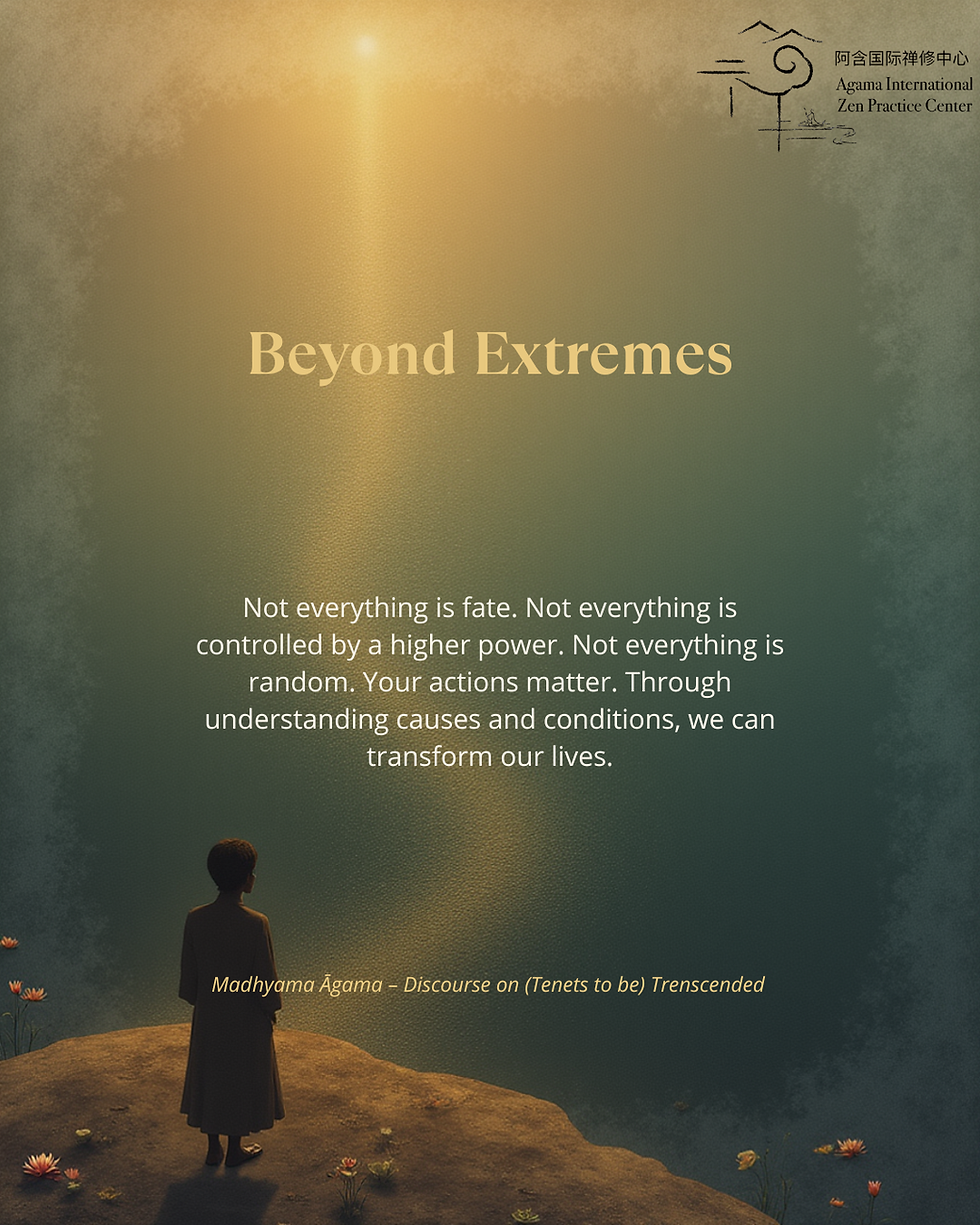
In other words, life is neither predetermined by fate, nor controlled by a divine power, nor random and causeless. Rather, it unfolds through conditions that can be understood and transformed.
The key to practice lies in the present moment: to truly understand suffering, to abandon craving, and to cultivate the path. Through this, one can move beyond confusion and gradually bring an end to suffering.
Editor's Note: From a Buddhist viewpoint, the question of fate and free will is not framed as an absolute either–or. The Buddha rejected the idea that everything is predetermined by past actions, just as he rejected the view that everything is random or controlled by an external power. Instead, he taught that our present experience arises from conditions—some shaped by the past, but also influenced by our current intentions and actions. In this sense, we are neither completely bound nor completely free; rather, we participate in an ongoing process where mindful choices can gradually transform the conditions of our lives.
Want to learn what the Buddha has to say? Join us and read the scriptures together!
今天分享一篇阿含经里佛陀的教导,祝大家开启正念的一天:
《中阿含·度经》
佛陀一次在祇树给孤独园,向诸比丘开示:世间有三种很常见但应当超越的见解—认为一切
1. 由过去业决定 (决定论)
2. 由神意创造,(神创论)
3. 或完全无因无缘。(随机论)
佛陀指出,这三种看法都会带来同样的问题:如果行为不是由当下的心与选择所决定,那么人就不需要努力,也无需为善恶负责,甚至杀生、妄语等行为都无法称为过失。这样一来,人便失去正念与正知,变得不可教化,修行之道也就断绝了。
因此,佛陀否定这些见解,而提出如实的因缘法:世间现象由感官(六根)与外界接触而产生(耳闻声,眼见色等),由接触而升起种种感受;正是依于“受”,修行人能够观察苦、知苦的生起、体证苦的止息,并修八正道。
换言之,生命既非宿命注定,也非神所操控,更非无因而起,而是在因缘条件中可以被认识、被转变。
修行的关键就在当下:如实知苦、断除贪爱、修习正道。
一起来读经,聆听佛陀的教导吧!

Comments